Project Overview
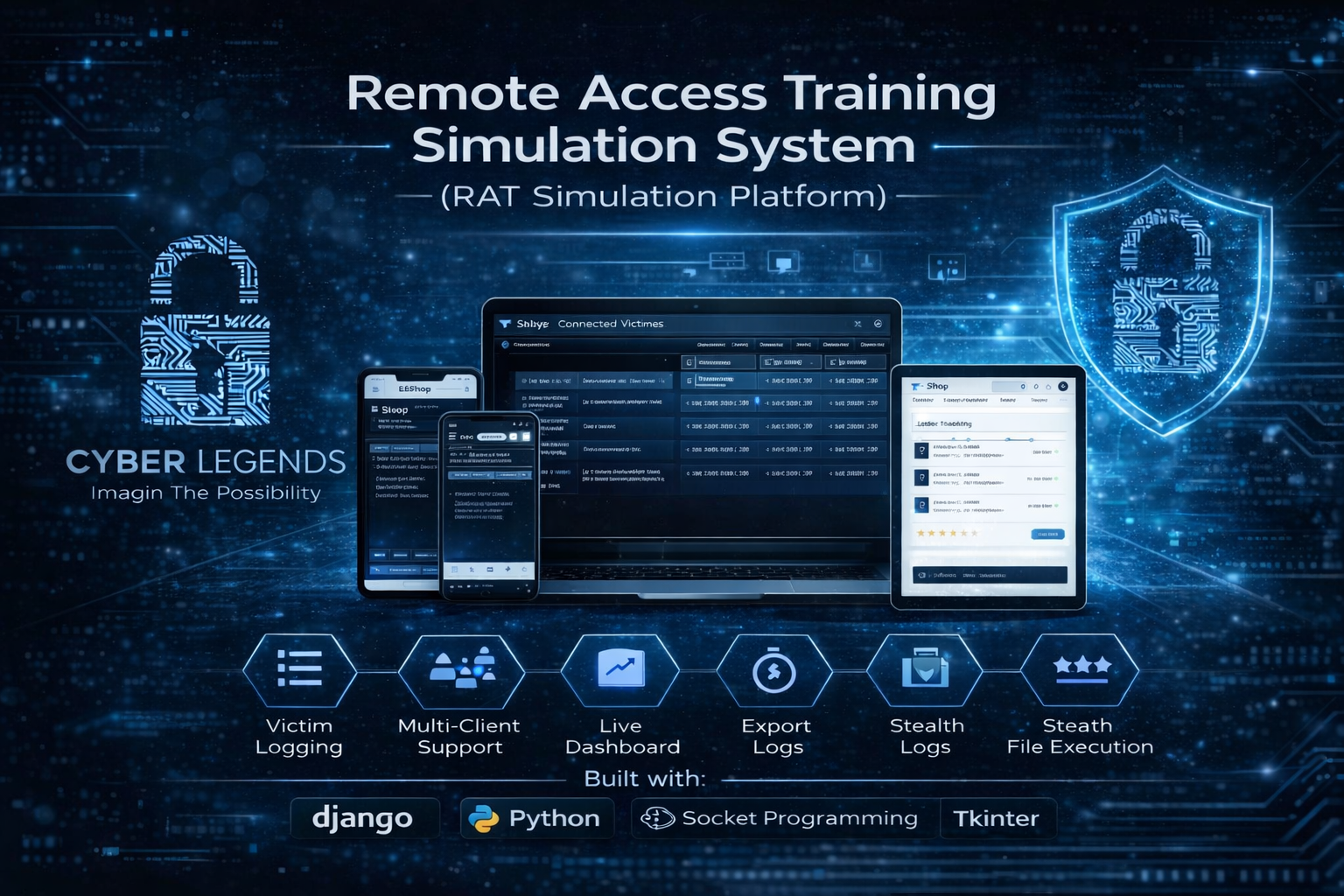
A full-stack cybersecurity training project designed to simulate real-world remote access tool (RAT) behavior in a controlled and ethical environment. The system combines a Django-powered web application with a Python-based GUI server to demonstrate how attackers track, connect, and manage multiple clients.
The web module captures visitor IP addresses and simulates open ports when users interact with an admission form. It then redirects users to a viewer page that triggers a controlled client download simulation. All visitor activity is logged and displayed in a live-updating dashboard with export functionality.
On the backend, a Tkinter-based RAT server provides multi-client support, allowing real-time monitoring, client selection, command execution, and log management. The system is built using socket programming to simulate client-server communication.
This project is ideal for demonstrating concepts in ethical hacking, penetration testing, and cybersecurity awareness, showcasing both attack simulation and monitoring mechanisms in a structured environment.
Key Challenges
-
Designing a reliable multi-client socket architecture for concurrent connections
-
Synchronizing real-time data between Django dashboard and GUI server
-
Handling thread safety in the server while managing multiple clients
-
Simulating realistic client behavior without using actual malicious techniques
-
Implementing live dashboard updates without WebSockets
-
Managing IP logging accurately behind proxies (X-Forwarded-For handling)
-
Ensuring smooth communication between frontend triggers and backend logging
Key Achievements
-
Successfully built a fully functional multi-client RAT simulation system
-
Implemented real-time victim tracking with auto-updating dashboard
-
Developed a complete GUI-based control panel for client management
-
Achieved seamless integration between web tracking and socket server
-
Enabled exportable logs for both server activity and victim tracking
-
Created a realistic cybersecurity training environment end-to-end
-
Delivered a modular and extensible architecture for future enhancements
Performance Metrics
-
Supports multiple simultaneous client connections (tested with 5–10 clients)
-
Logs and tracks 100% of incoming visitor IPs in real-time
-
Dashboard refresh interval: ~5 seconds (near real-time updates)
-
Command execution latency: <1 second (local network)
-
Log export generation time: <2 seconds
-
System uptime stability during testing: 99%+ for continuous sessions